The Hardware
High-Frequency Data Processing
The Shark of Wall Street · Dossier
Sting Ray — The Calculus of Violence
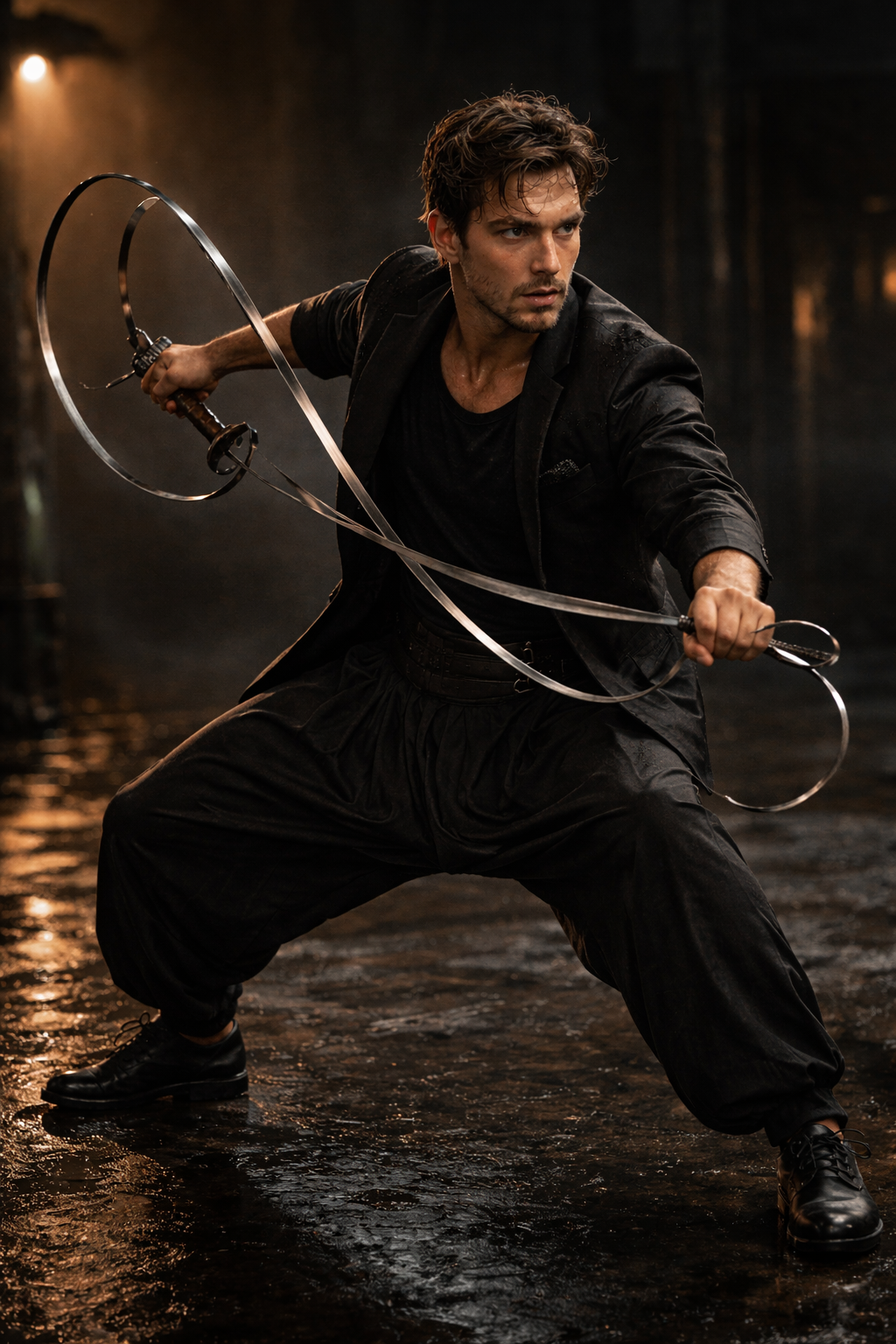

Sting Ray was always sweating. It wasn’t anxiety. It wasn't fear. It was pure thermodynamics.
As the Lead Quantitative Analyst for the World Trade Factory, his brain was a localized supercomputer. While normal traders looked at lines on a chart, Sting Ray looked at the raw architecture of global liquidity. He processed fourteen thousand calculations a second—evaluating interest rate swaps, algorithmic arbitrage, and sovereign debt yields simultaneously. His core body temperature ran permanently high because his mind refused to shut off. He was perpetually overclocked.

The problem with an overclocked system is that without a heat sink, the motherboard eventually melts. Sting Ray couldn't wear traditional Wall Street wool and heavy cotton; he wore fluid, unrestrictive tech-sartorial pieces that vented heat and allowed him absolute freedom of movement. He needed an anchor. He needed a physical outlet that demanded the exact same level of flawless, geometric precision as his high-frequency trading models.
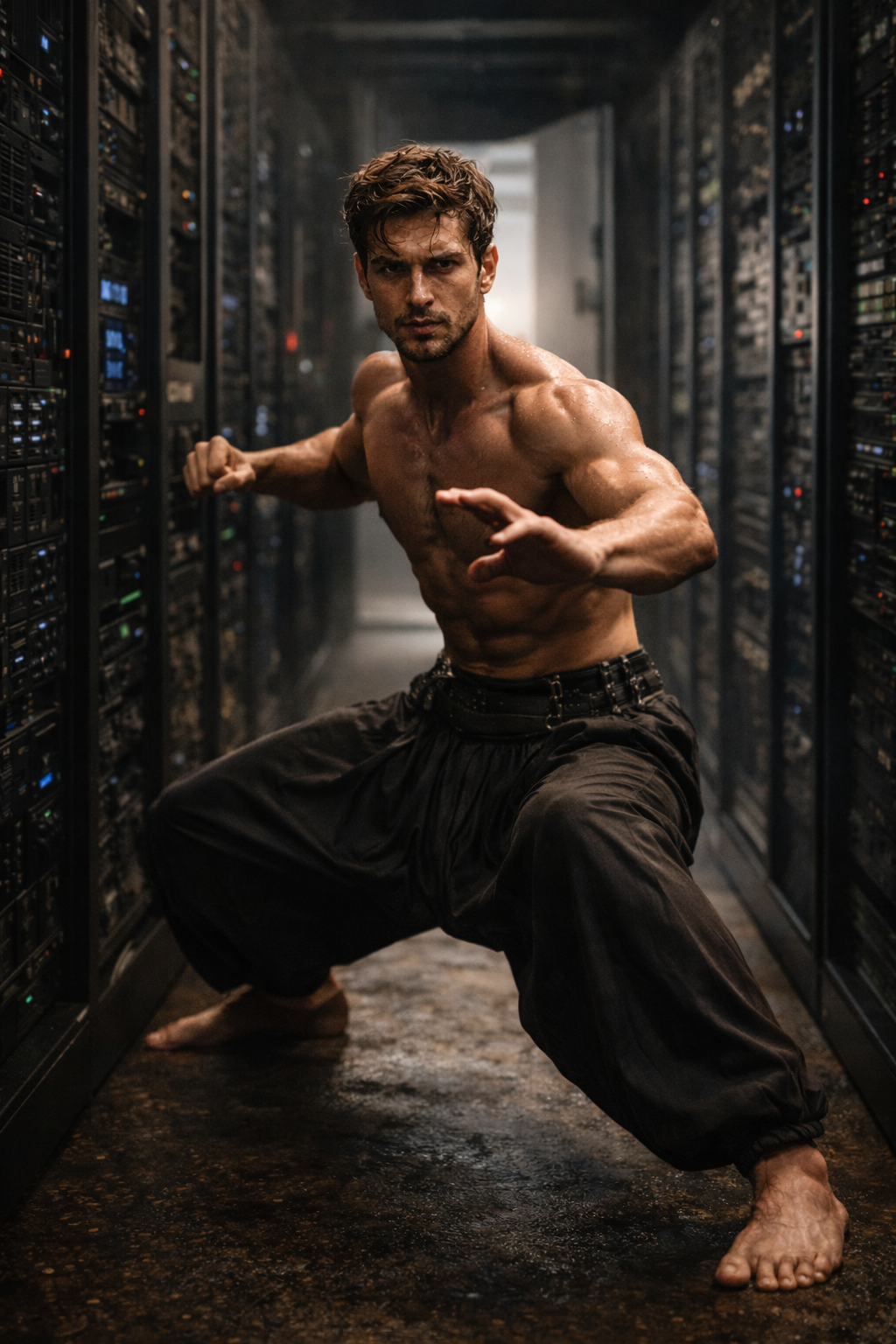
He found it in the oldest martial art on the planet.
Sting Ray wasn't born into a warrior culture. He was born in a sterile, upper-class suburb of Chicago. By the age of twenty-two, he was a prodigy building latency-arbitrage algorithms for a ruthless midwestern hedge fund. But his mind was fracturing. The human body is not meant to run at a permanent, overclocked redline. He suffered from severe insomnia, nosebleeds, and a core temperature that left him constantly drenched in sweat. He needed a physical anchor to bleed off the kinetic energy, but traditional combat sports failed him.
He tried Western boxing, Krav Maga, and Brazilian Jiu-Jitsu, but he found them sloppy. They were finite and discrete—strike, block, stop, reset. They lacked mathematical continuity. Sting Ray's brain operated in infinite loops, and he needed a martial art that did the same.
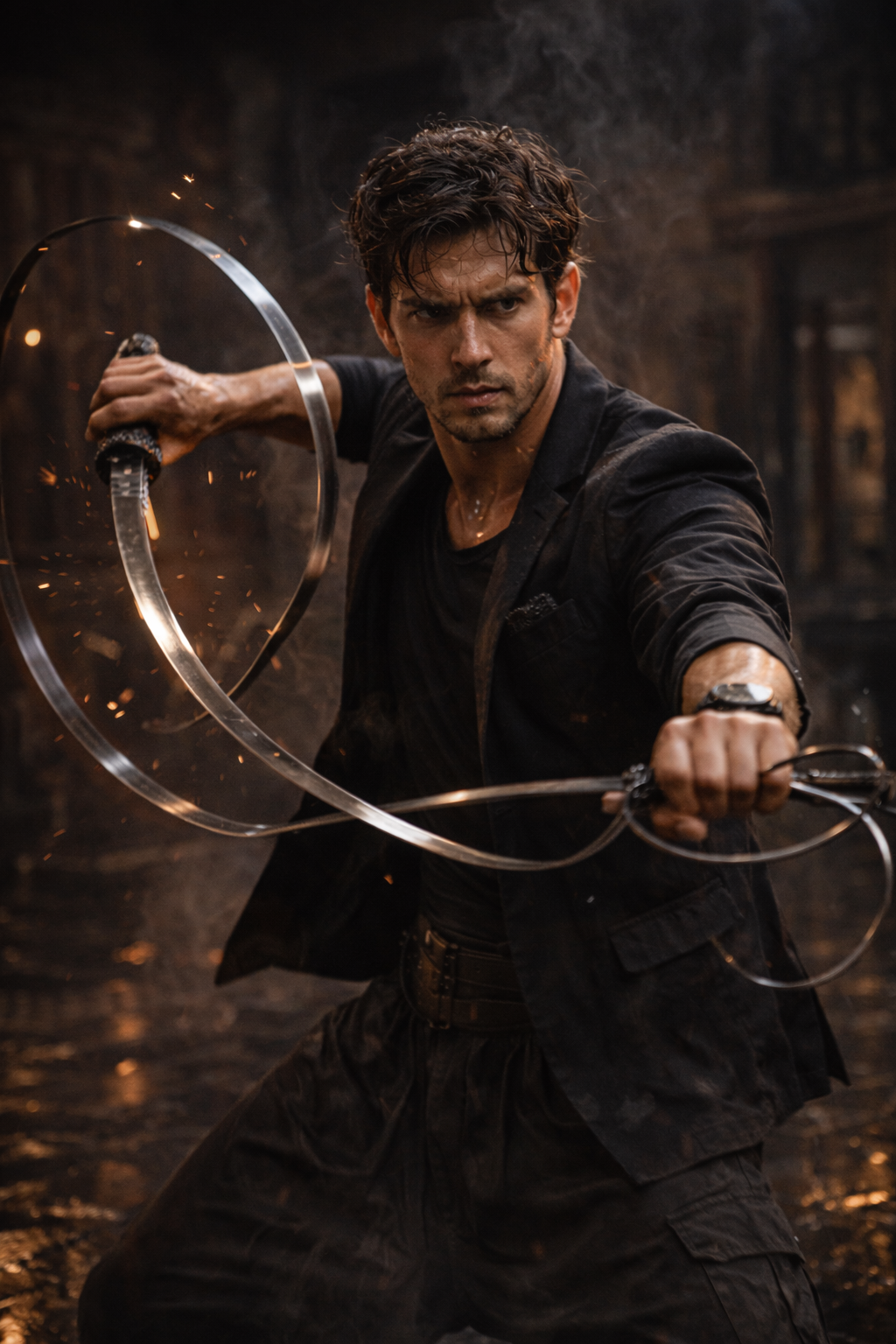
Late one night, while analyzing the fluid dynamics of algorithmic market crashes, he stumbled across archived, low-resolution footage of a South Indian martial artist wielding an Urumi—the flexible, whip-like sword. Sting Ray froze the video frame by frame. He didn't see a man fighting. He saw applied physics. He saw centrifugal force, the Fibonacci sequence, and absolute, unbroken kinetic momentum. The Urumi wasn't just a weapon; it was an algorithm made of steel.
A week later, Sting Ray quit his job, dropped off the grid, and flew to Trivandrum.
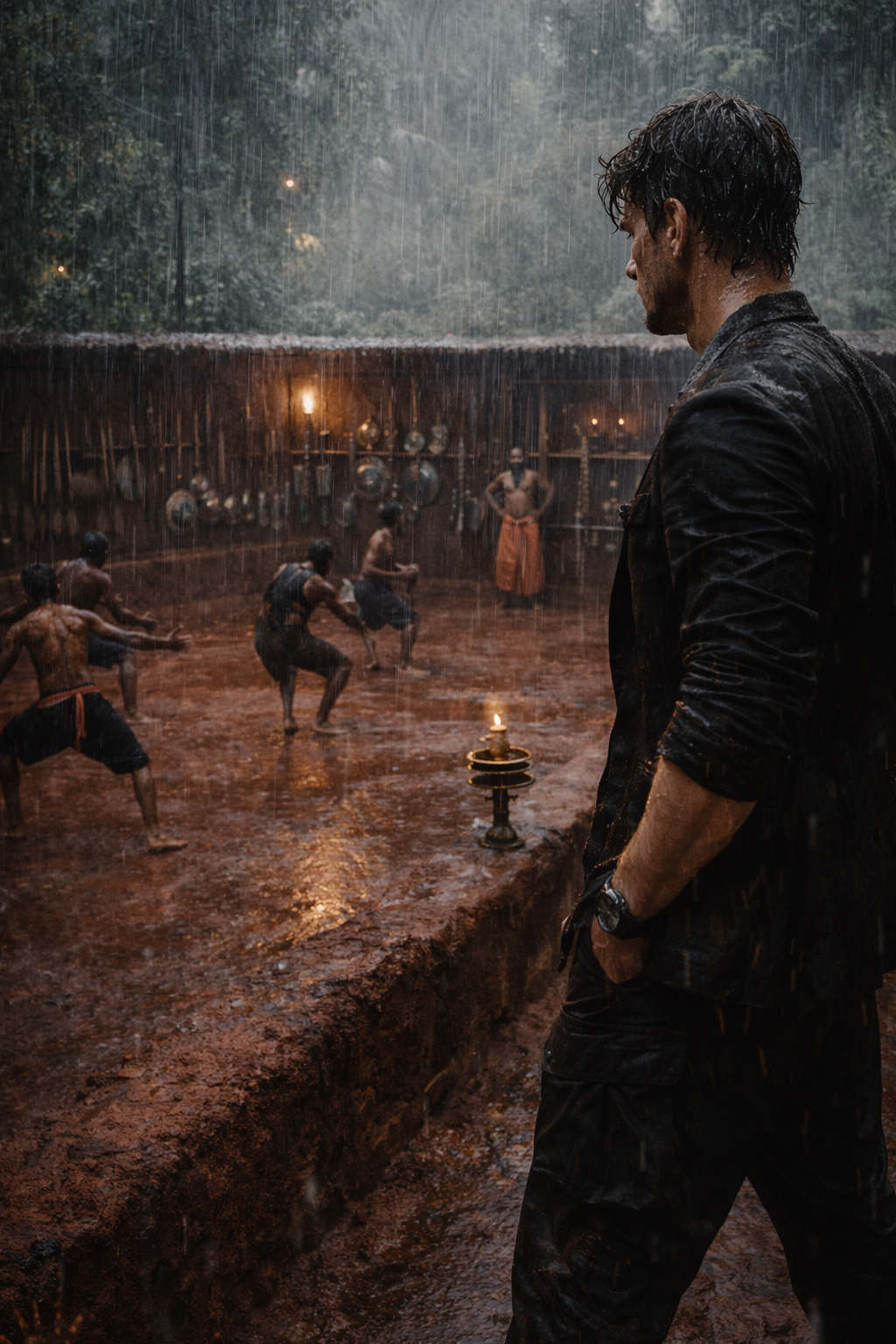
He traveled deep into the humid, monsoon-soaked jungles of the Western Ghats until he found a traditional Kalari—a training ground dug into the red clay earth, historically closed to outsiders. The resident Gurukkal (master) ignored the pale, sweating American for three weeks. Sting Ray didn't speak a word of Malayalam. Instead of asking, he simply stood in the torrential rain outside the pit every morning, perfectly mirroring the intricate, circular footwork (Chuvadu) the students were practicing inside. He didn't learn the moves through culture; he reverse-engineered the geometry.
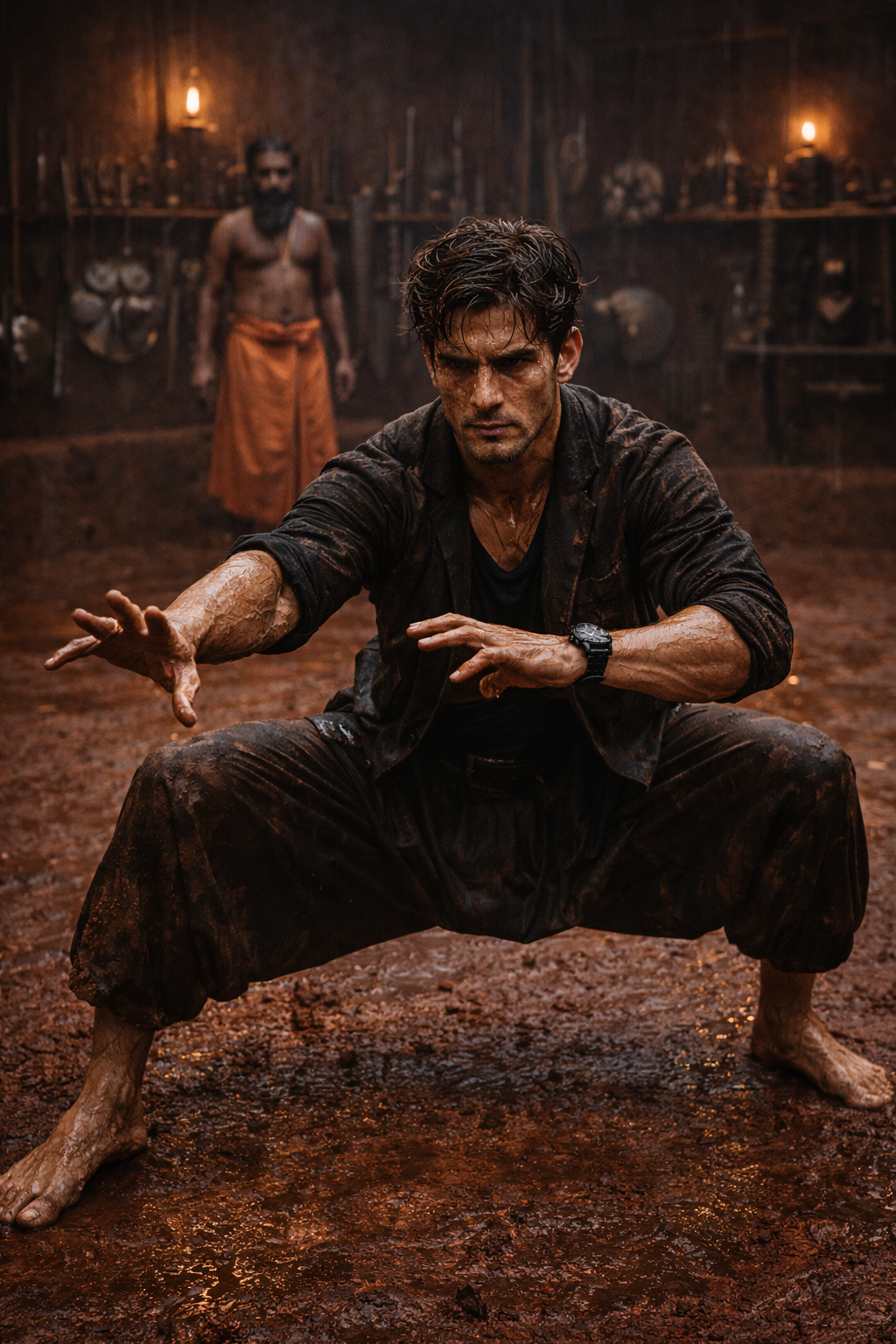
The Gurukkal eventually let him into the mud pit. For three brutal years, Sting Ray subjected his body to the ancient discipline. He underwent agonizing Uzhichil (medicinal oil massages) to physically alter the pliability of his muscles and tendons, allowing him to sink into the inhumanly deep animal postures. He learned the deadly science of Marmam—the 107 vital pressure points of the human nervous system. Kalaripayattu became his physical heat sink. It saved his mind.
That was how he eventually met The Shark.
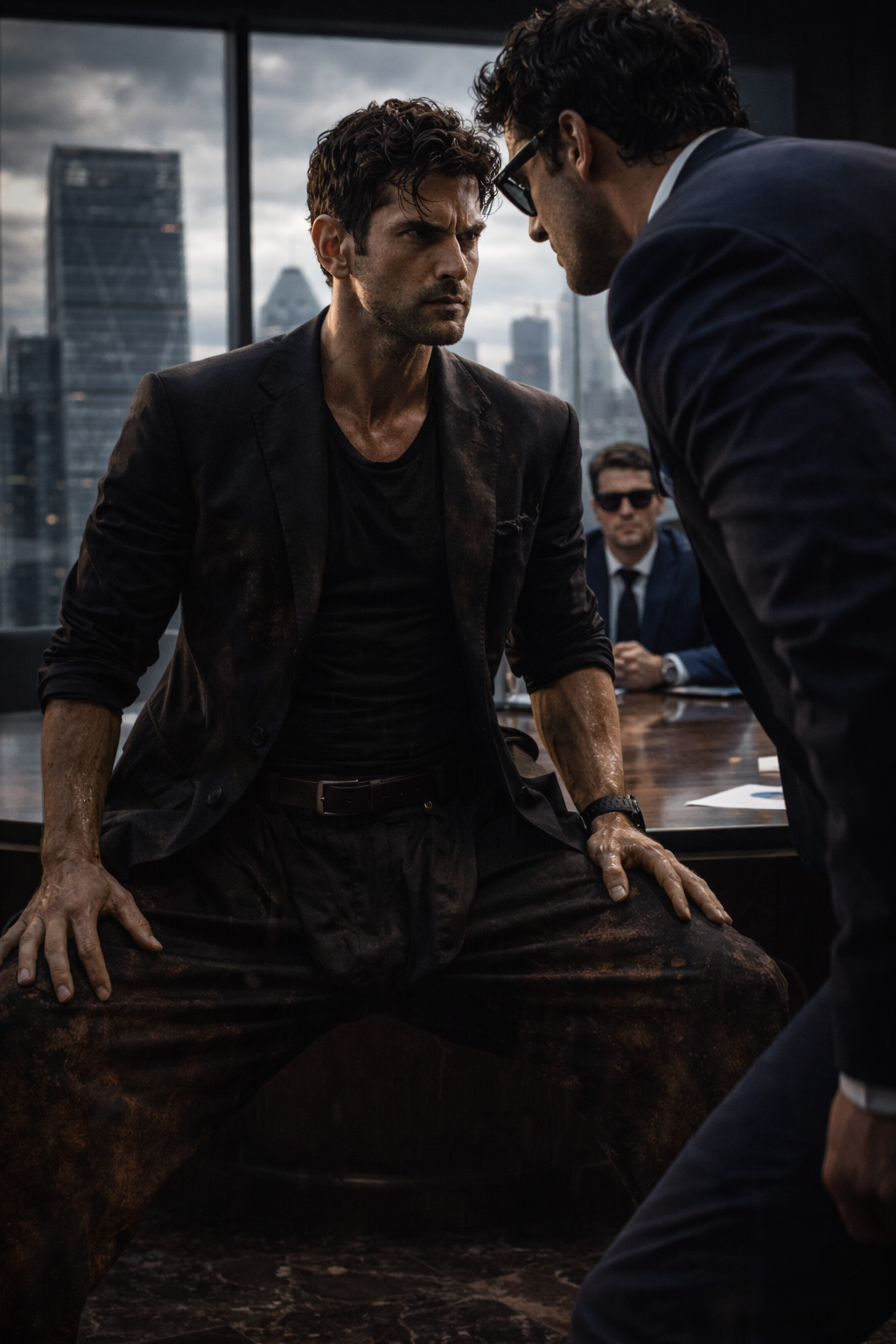
The Shark, a native son of Kerala, recognized the stance immediately during a tense negotiation in a London boardroom years later. When a rival hedge fund manager aggressively invaded Sting Ray's physical space, Sting Ray hadn't recoiled. He had seamlessly shifted his weight into the Gaja (Elephant) stance, sinking his center of gravity into the floor, completely neutralizing the man's kinetic threat without lifting a finger.
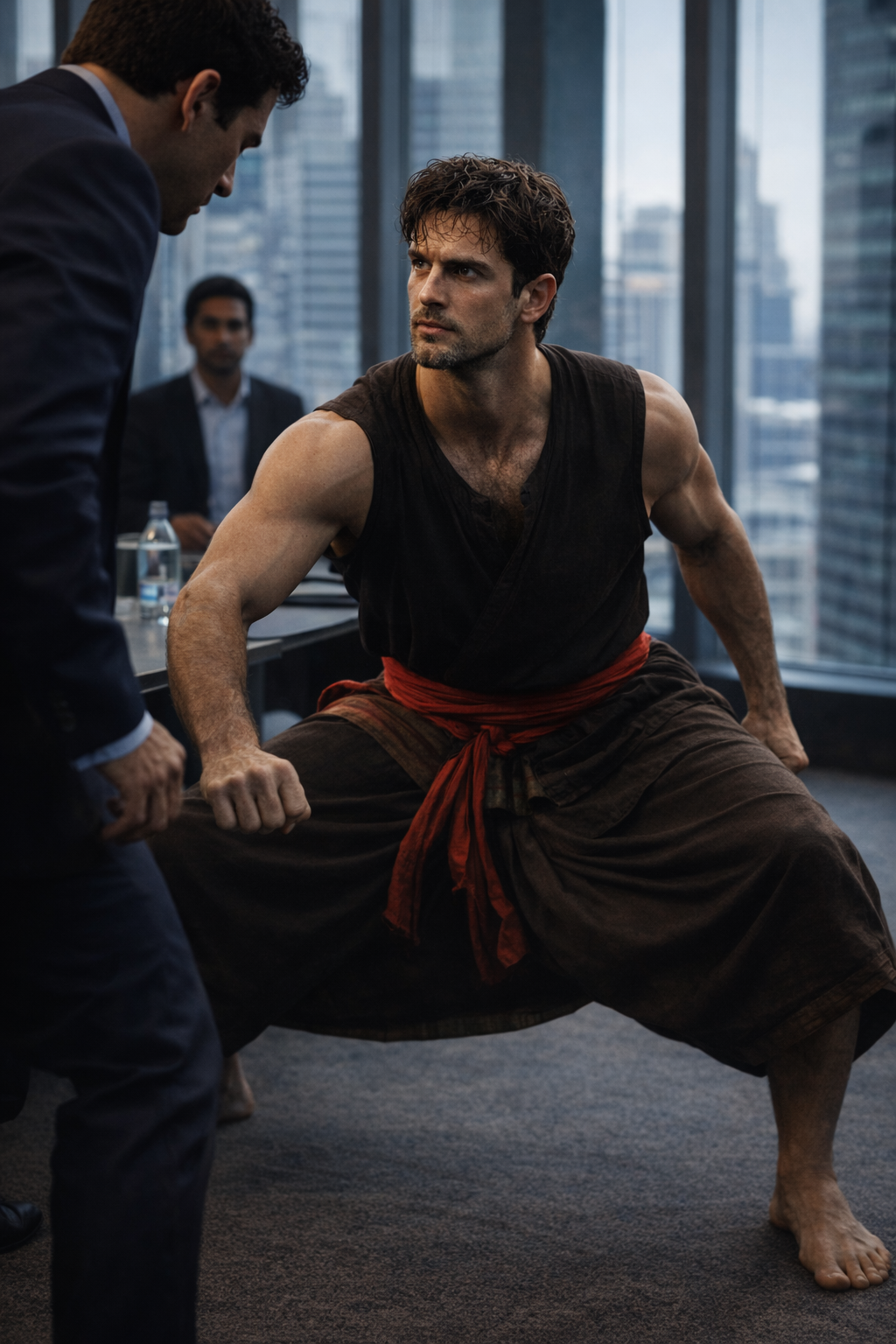
The Shark saw the deep cultural resonance, but more importantly, he saw what it must have cost this American to learn it. He saw a man who understood that markets, like combat, were just the manipulation of energy, geometry, and flow. Sting Ray wasn't just an employee; he was a lethal, perfectly calibrated weapon.
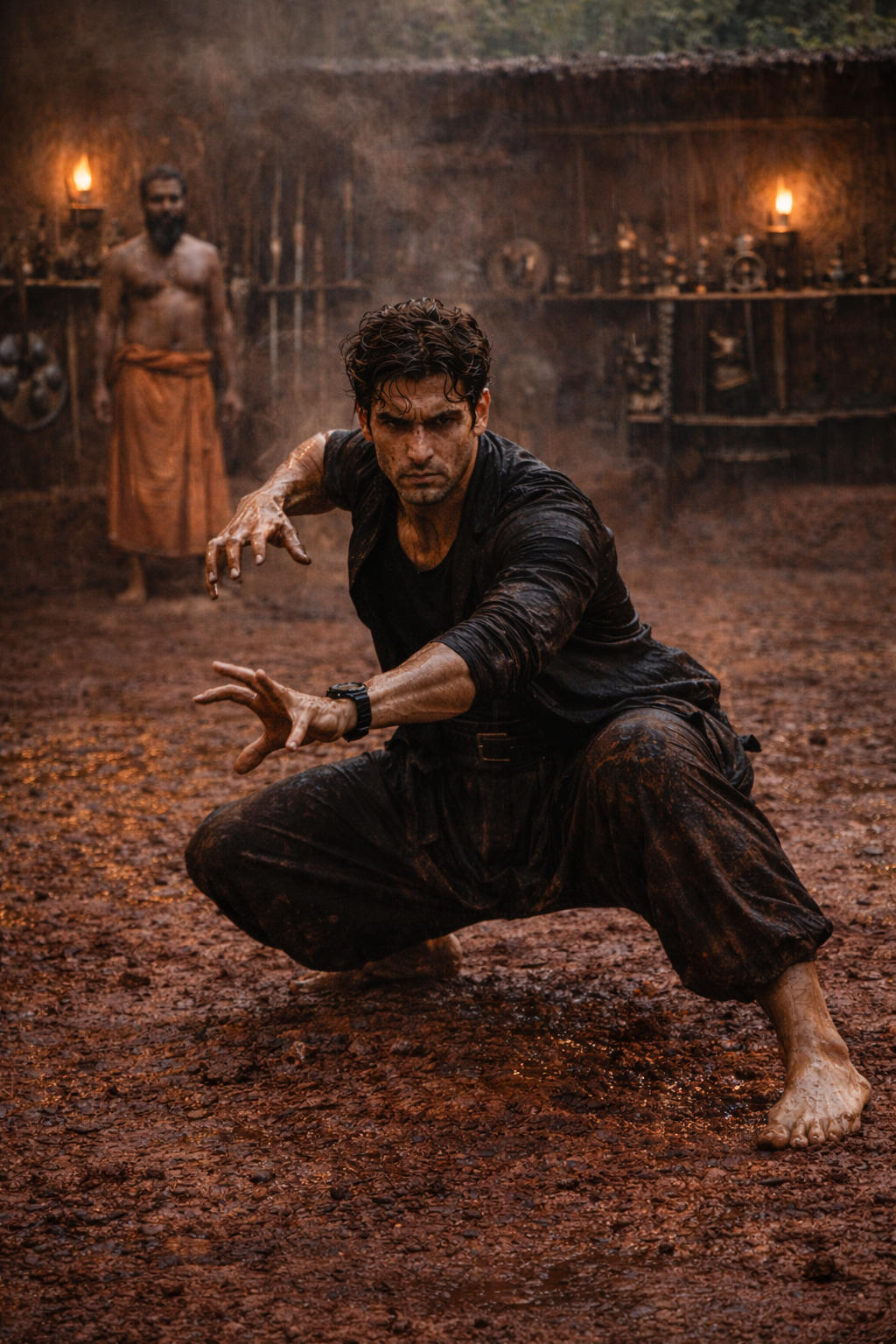
To understand Sting Ray, one must understand the geometry of his violence. Before Krav Maga, before Muay Thai, and thousands of years before an Indian monk named Bodhidharma traveled to China to lay the foundations for Shaolin Kung Fu, there was Kalaripayattu.
Originating over three thousand years ago in the southwestern state of Kerala, it is widely considered the mother of all martial arts. But it is not a sport. There are no points, no rings, and no referees. It was designed for ancient battlefields where survival depended on absolute, continuous momentum.
The training does not take place in a gym; it takes place in a Kalari—a rectangular pit dug four feet into the dense red clay of the earth, aligned perfectly on an east-west axis. The pit is a crucible designed to trap the intense, suffocating heat of the jungle, forcing the practitioner to master their oxygen intake and internal thermodynamics.
Sting Ray didn't view the art as mysticism; he viewed it as biological calculus.
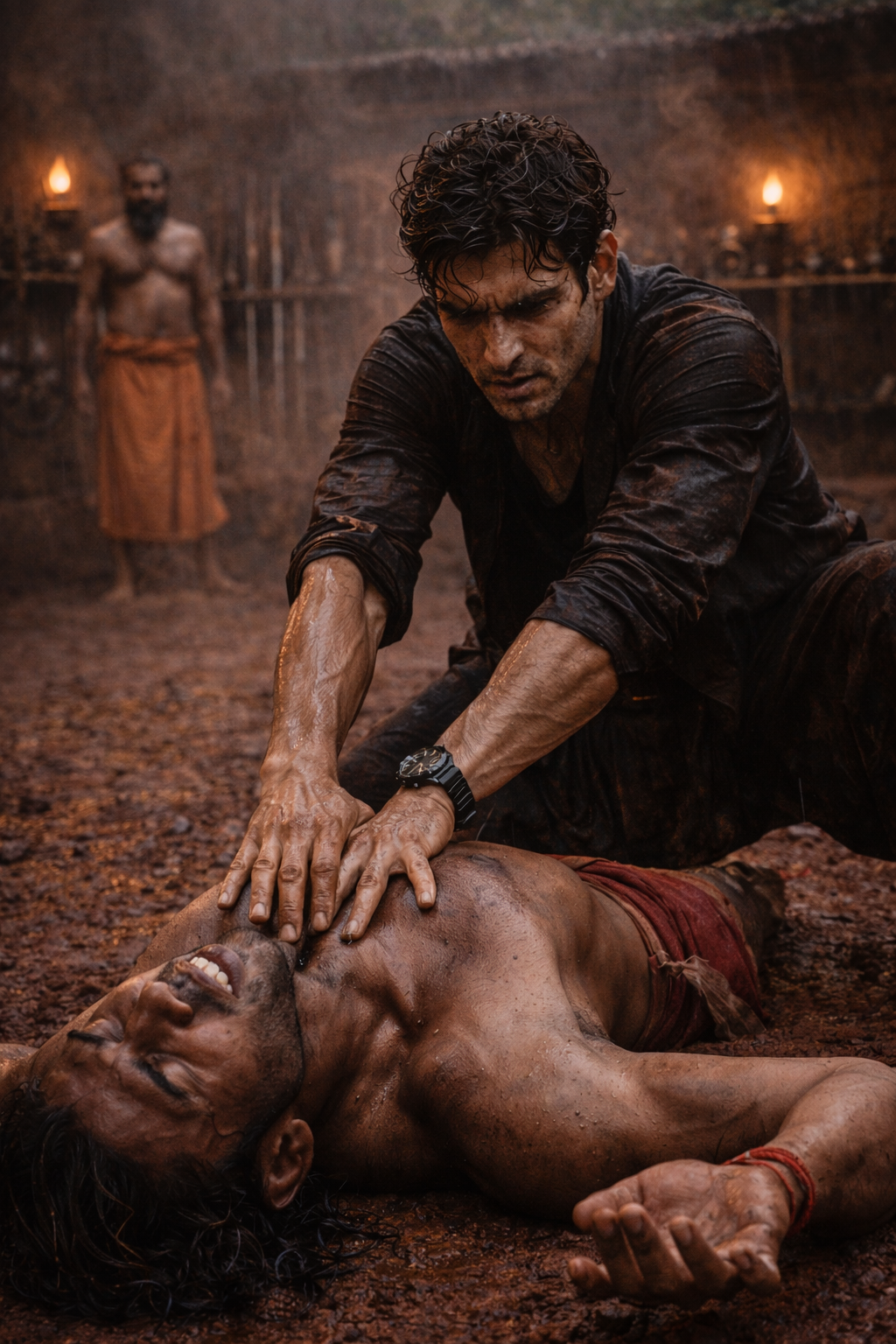
The foundation of Kalari is built on the Vadivu (animal postures)—such as the Elephant, the Lion, and the Serpent. To a layman, they look like mythological stances. To a quantitative analyst like Sting Ray, they are pure structural engineering. They are the mathematical perfection of weight distribution, allowing the human body to lower its center of gravity and generate massive kinetic force from the ground up.
But the true terror of Kalaripayattu lies in Marmashastra—the science of the 107 vital pressure points of the human anatomy. A Kalari master does not need to rely on blunt force trauma. By striking specific intersections of nerves, veins, and joints at the exact right angle, they can paralyze a limb, short-circuit the nervous system, or stop a human heart with a single, open-palmed strike.
It is a discipline where healing and killing are two sides of the exact same coin. To Sting Ray, the global economy and the human nervous system were identical: both were highly complex networks that could be entirely shut down if you knew exactly where to apply the pressure.
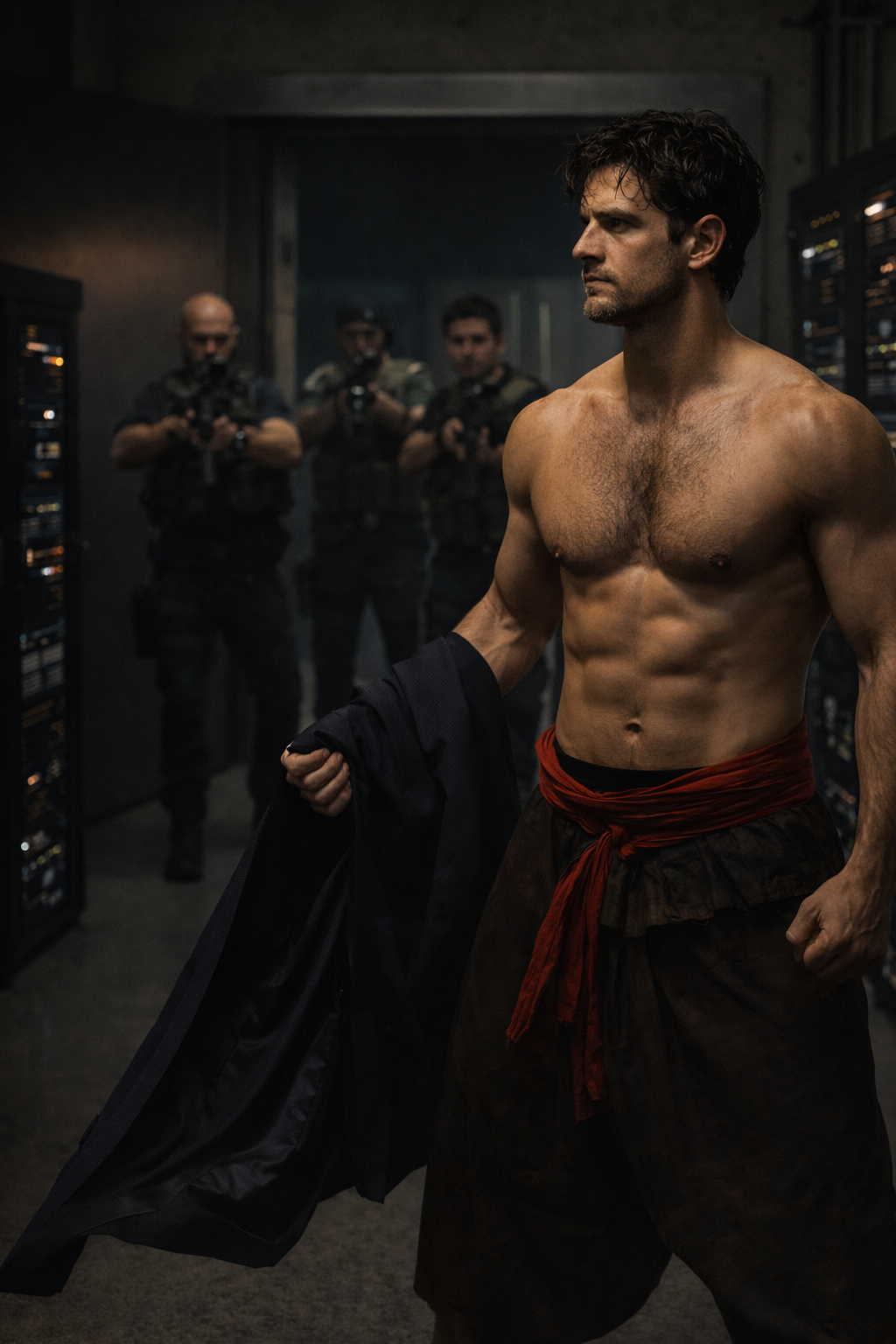
A month before the Obsidian Tower heist, Tariq Al-Fayed’s syndicate attempted a quiet data breach. They sent three corporate espionage agents—ex-Mossad, heavily armed—into an underground server relay in New Jersey that handled the World Trade Factory's proprietary trading algorithms.
Sting Ray happened to be there, manually patching a latency issue.
When the heavy steel door of the server farm kicked open, Sting Ray didn't pull a gun. He calmly shrugged off his unstructured, graphene-infused tech-blazer. He took a deep breath, slowing his racing heart, bringing his internal processor down from the macro-economy to the immediate physical room.
He saw the narrow aisles between the server racks not as a trap, but as a geometric funnel.
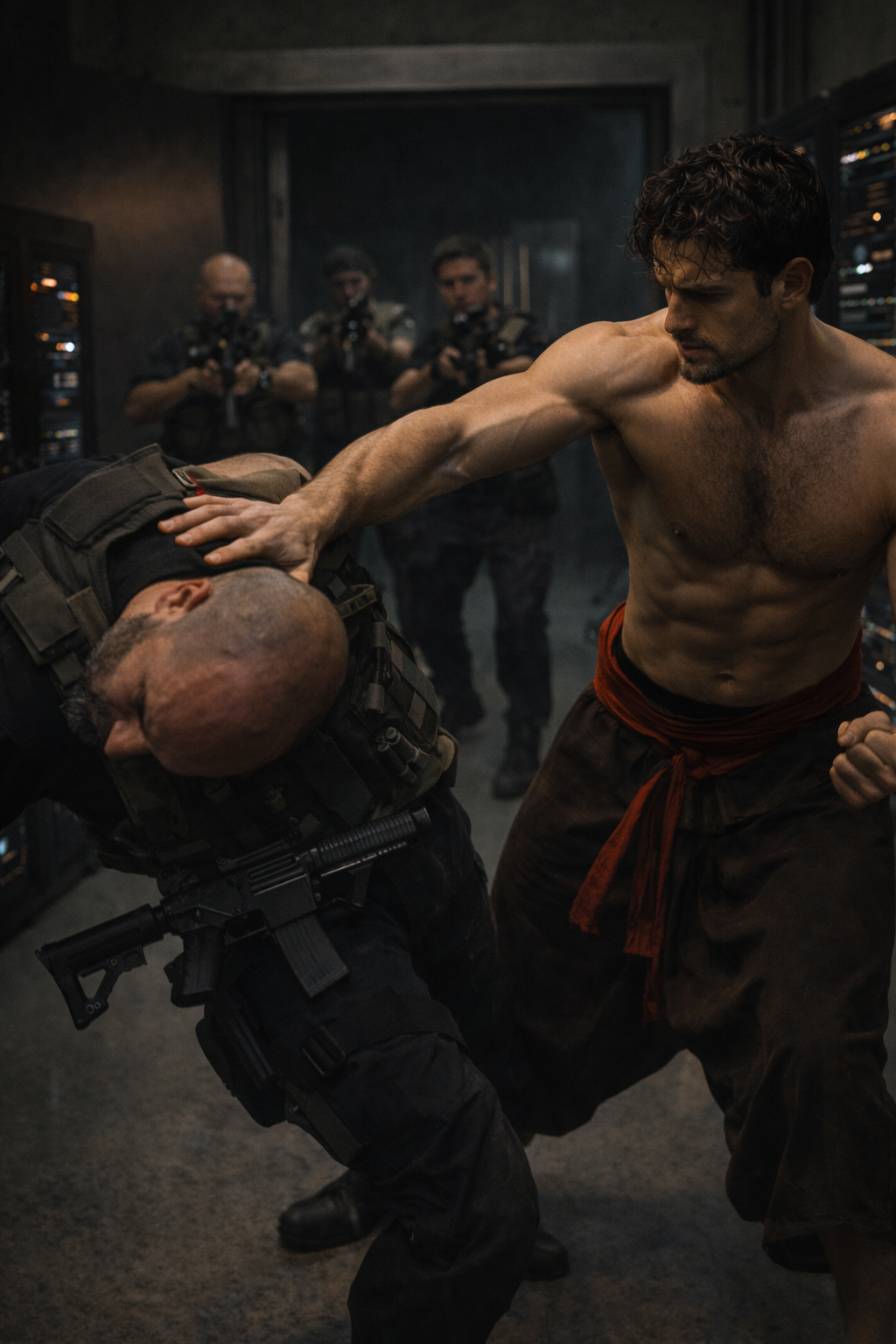
The first agent lunged. Sting Ray flowed underneath the strike, his body tracing a perfect, unbroken circle. Using the agent's own forward momentum, Sting Ray drove an open-palm Marmam strike directly into the brachial plexus under the man's arm. The agent collapsed instantly, his nervous system short-circuiting.
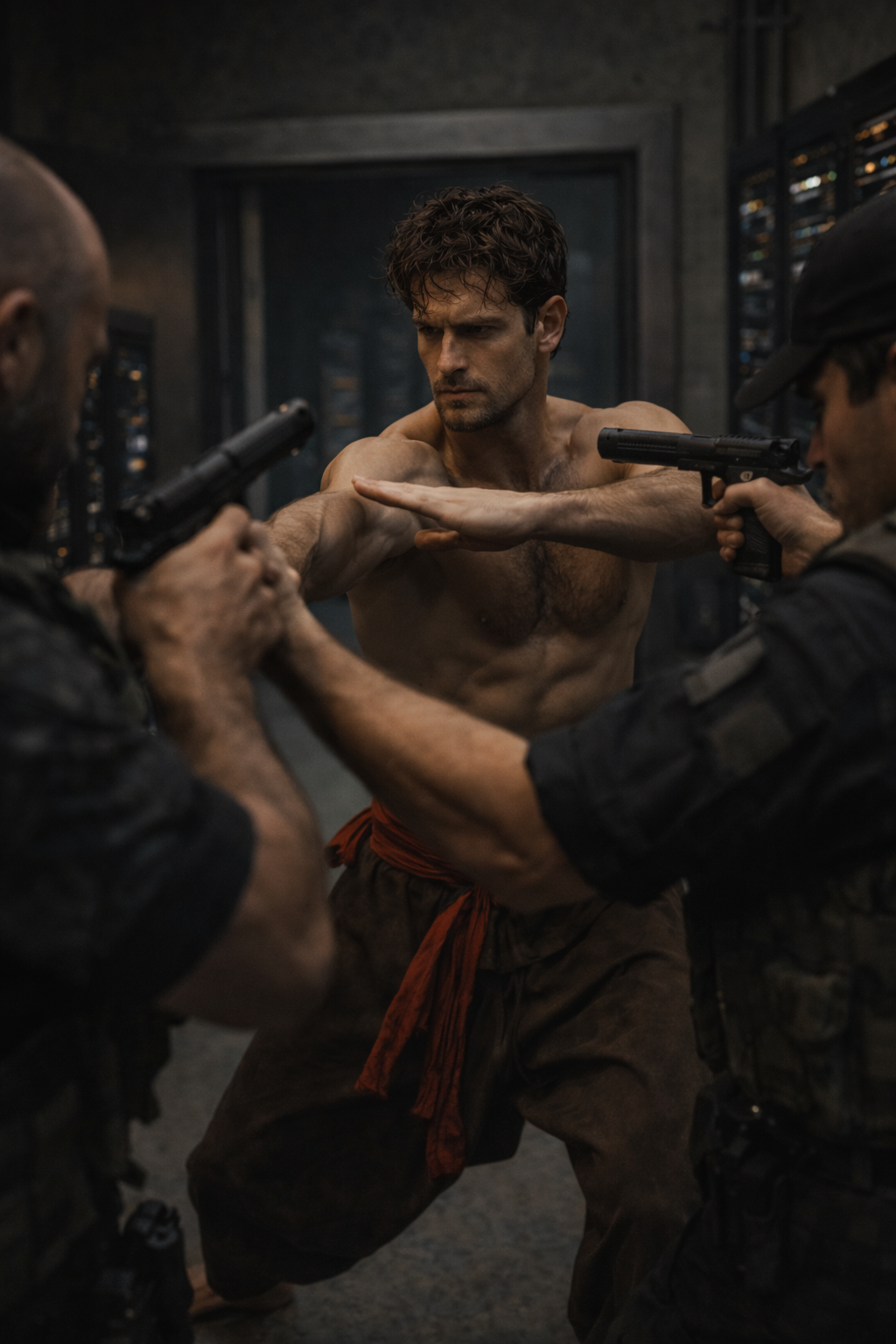
The second and third agents drew their suppressed weapons, but the aisle was too narrow for a clear shot without hitting the servers. Sting Ray moved with blinding, fluid continuity. He didn't block; he deflected. He became the current.
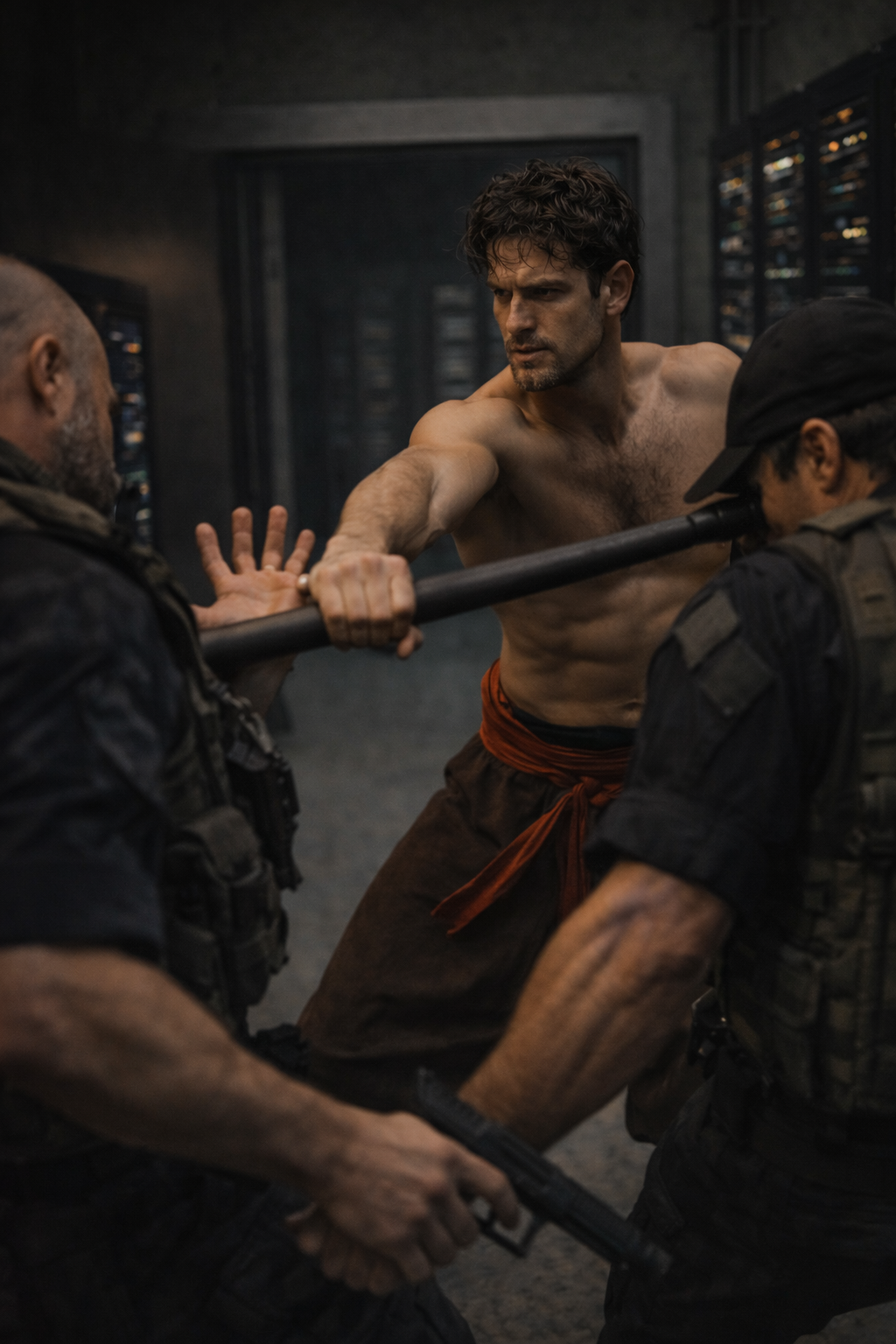
He swept a heavy server maintenance baton from a nearby rack, wielding it like a traditional Kettukari staff. He shattered the second man's wrist with a sickening crack, spinning on his heel to drive the blunt end of the baton directly into the third man's solar plexus.
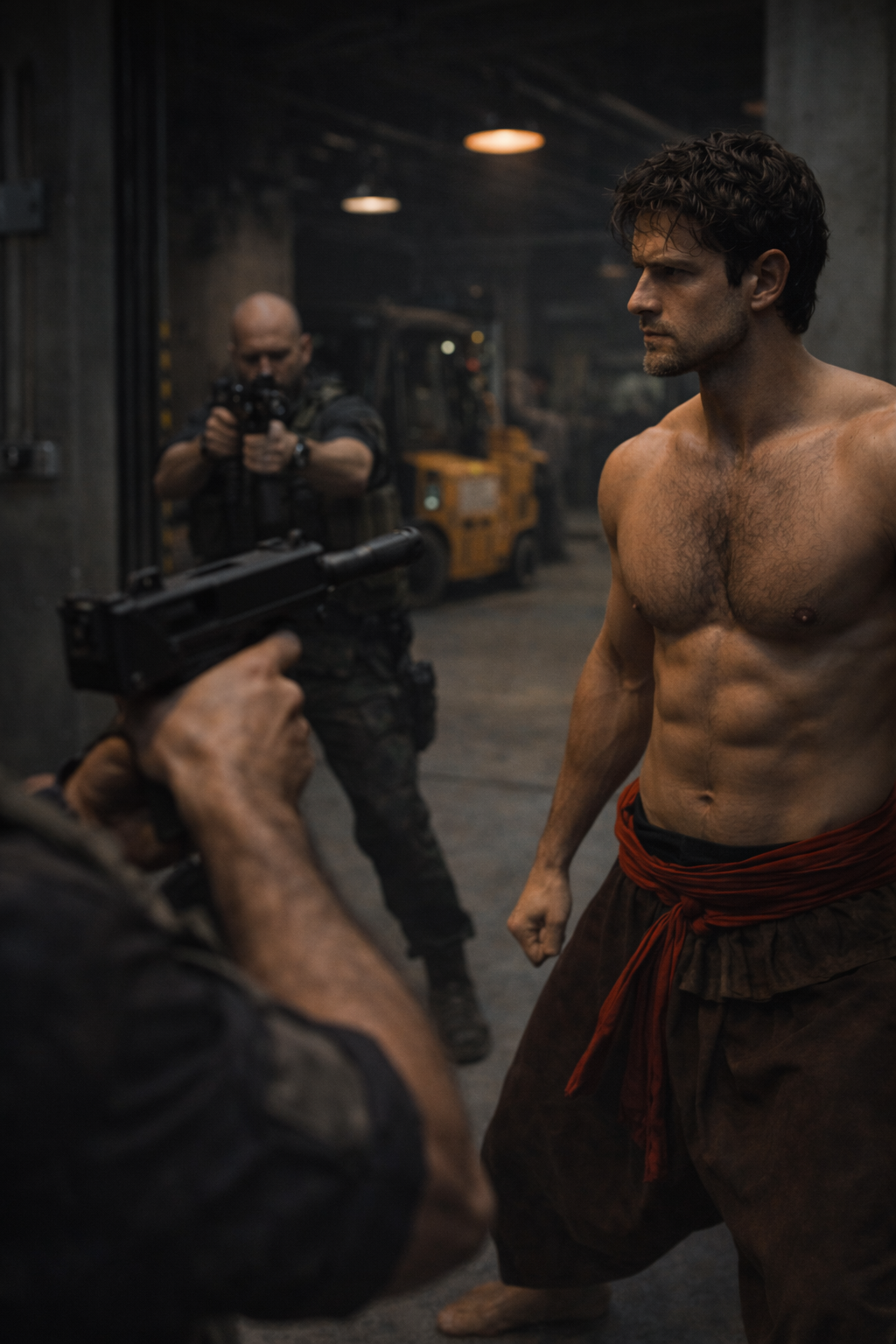
The immediate threat in the server aisle was neutralized, but the breach wasn't over. As Sting Ray stepped out into the main loading bay, a fourth operative—the extraction element—was waiting. And he wasn't carrying a suppressed pistol. He was holding a compact, fully automatic MAC-10 submachine gun.
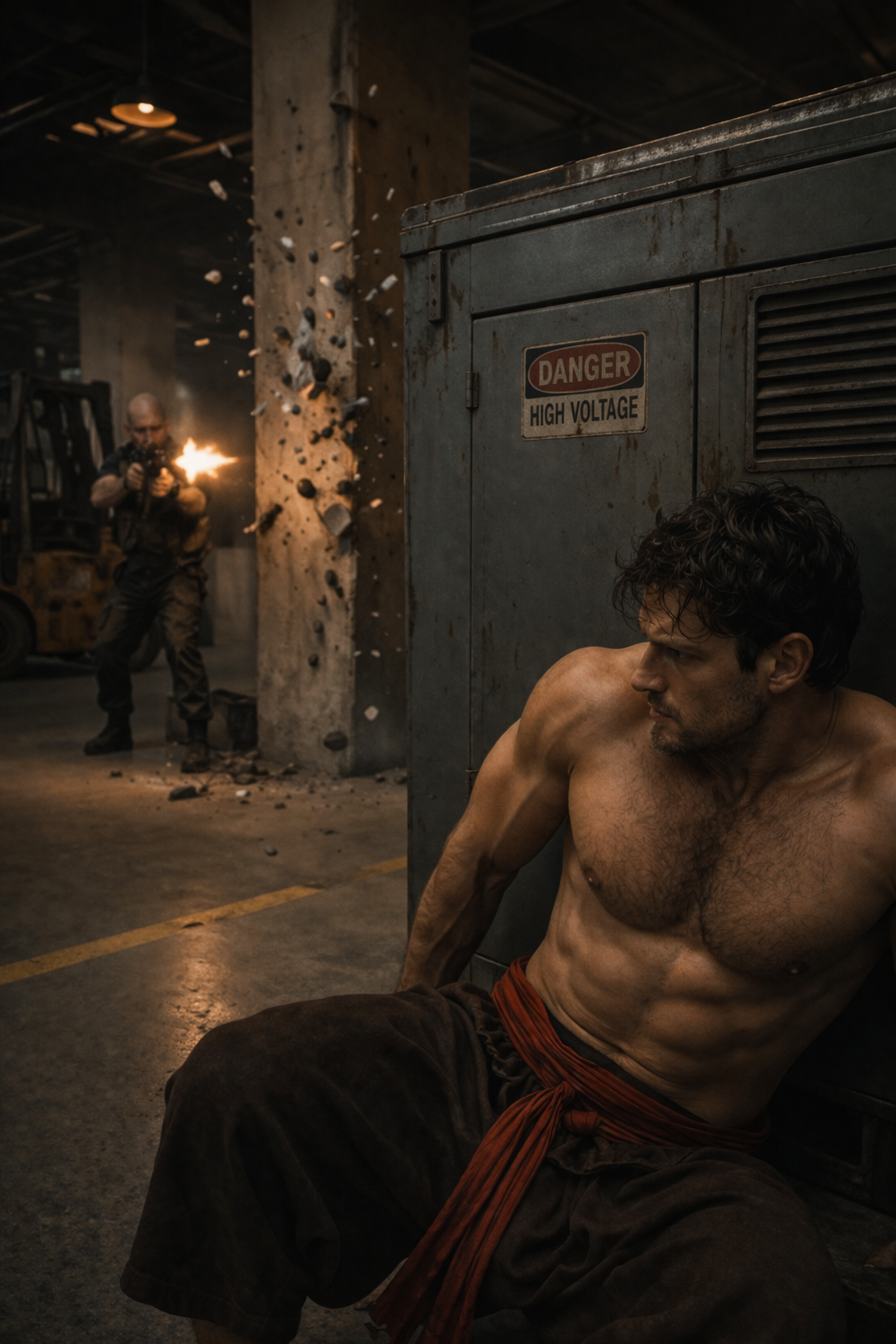
The man opened fire. The concrete pillars behind Sting Ray exploded into jagged shrapnel as the 9mm rounds chewed through the loading bay. Sting Ray dove behind a heavy steel generator casing, his mind racing. He couldn't deflect bullets with a maintenance baton, and he couldn't close the fifty-foot gap before the operative reloaded.
He needed distance control. He needed the Urumi.
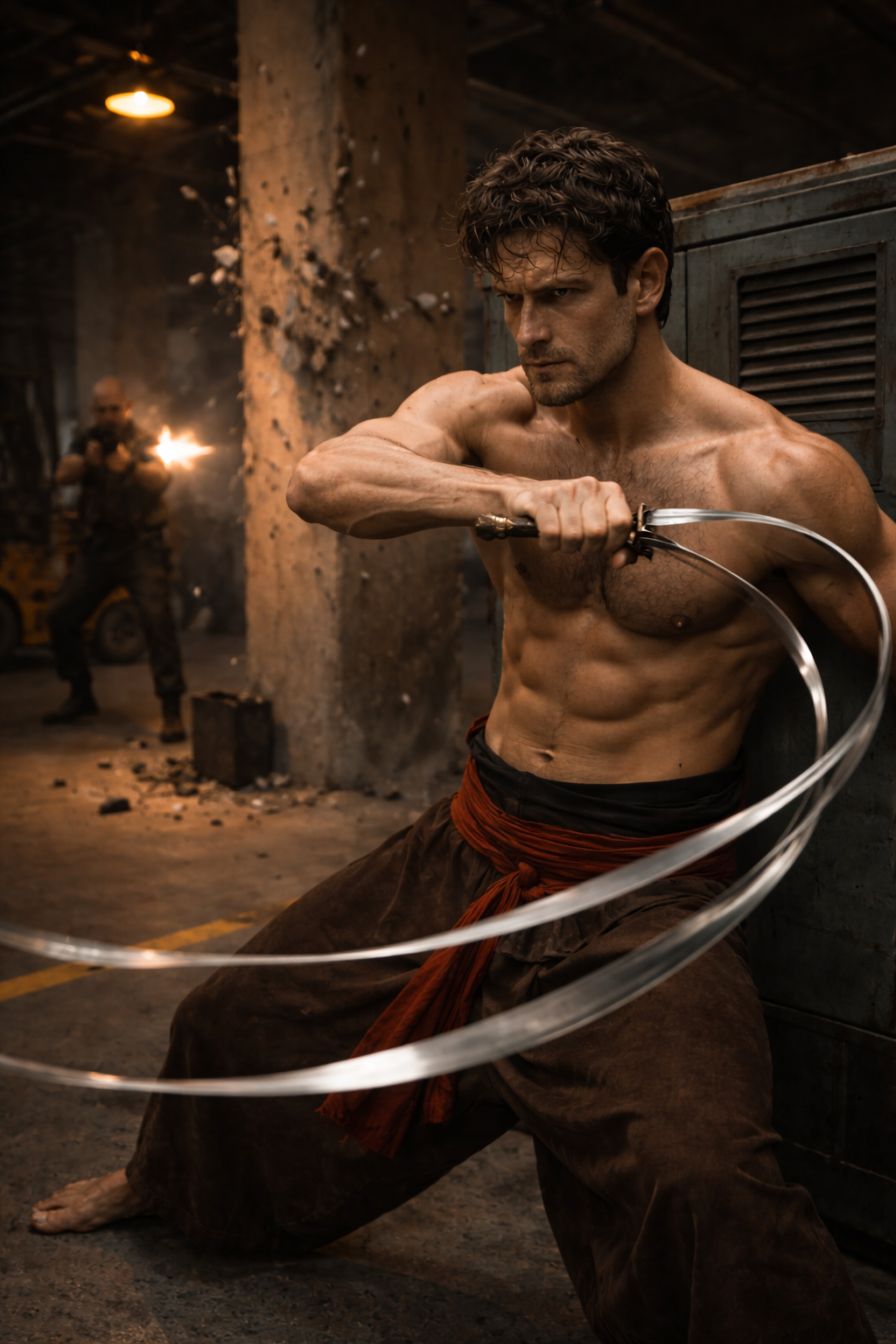
Sting Ray reached under his moisture-wicking knit shirt to the specialized leather harness wrapped tightly around his waist, perfectly concealed by the drape of his wide-tapered articulated trousers. With a sharp flick of his wrist, he unspooled his concealed weapon. The Urumi—a traditional Kalaripayattu flexible sword made of three long, razor-sharp ribbons of tempered spring steel—snapped into the air with a terrifying, metallic hiss.
The operative dropped his empty magazine and slammed a fresh one into the MAC-10. "You're dead, suit!"
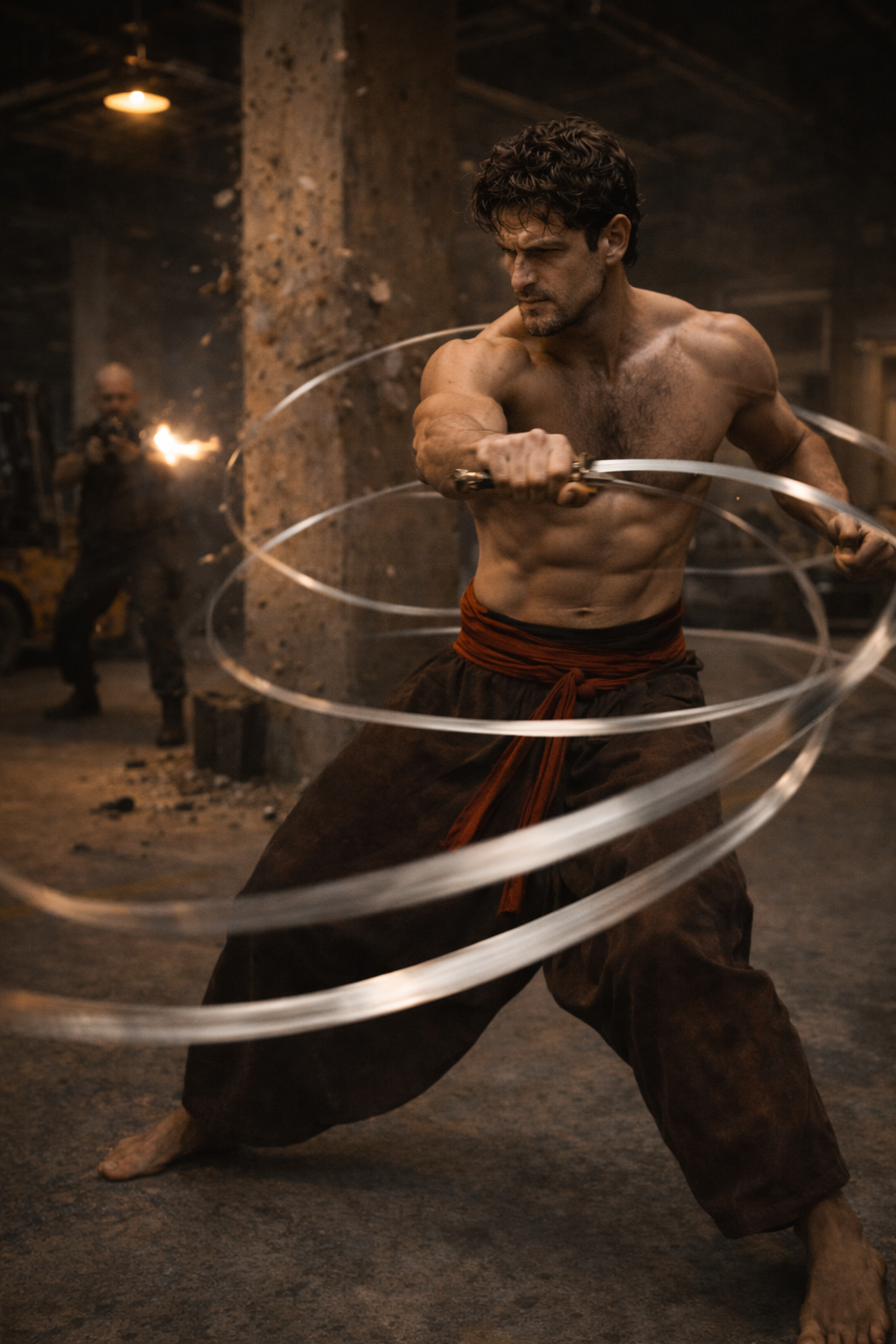
Sting Ray stepped out from behind the generator. He didn't charge. He began the Chuvadu—the continuous, hypnotic circular footwork of Kalari. He spun the Urumi around his body in a blinding, continuous figure-eight motion. The flexible steel ribbons whipped through the air, creating a shimmering, lethal barrier of movement.
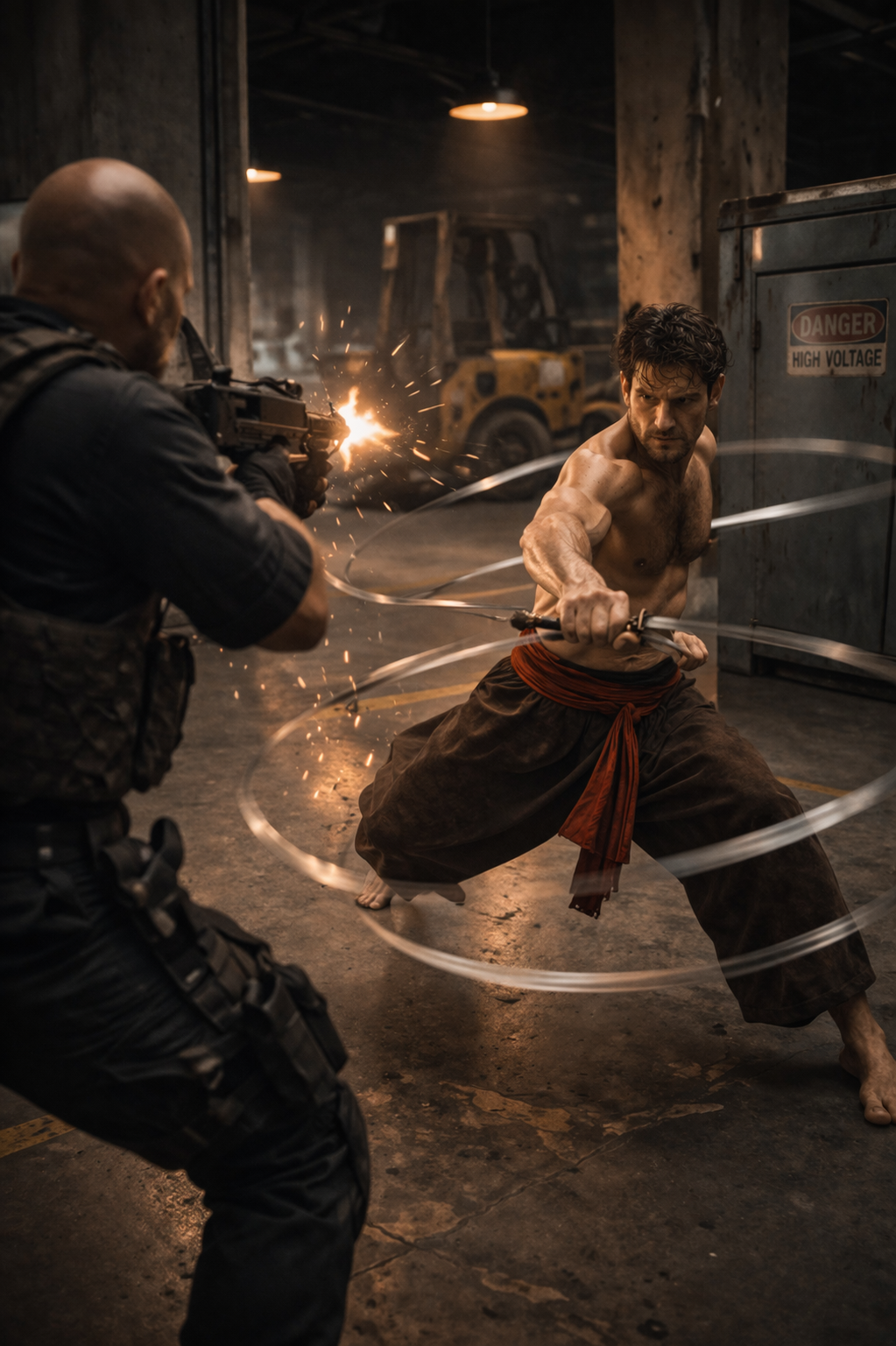
The operative fired a burst, but the distraction of the flashing steel and Sting Ray's erratic, circular momentum caused the shots to go wide, sparking harmlessly against the concrete floor. Sting Ray used the momentum of the spin to close the distance, advancing at an aggressive angle that kept him out of the direct line of fire.
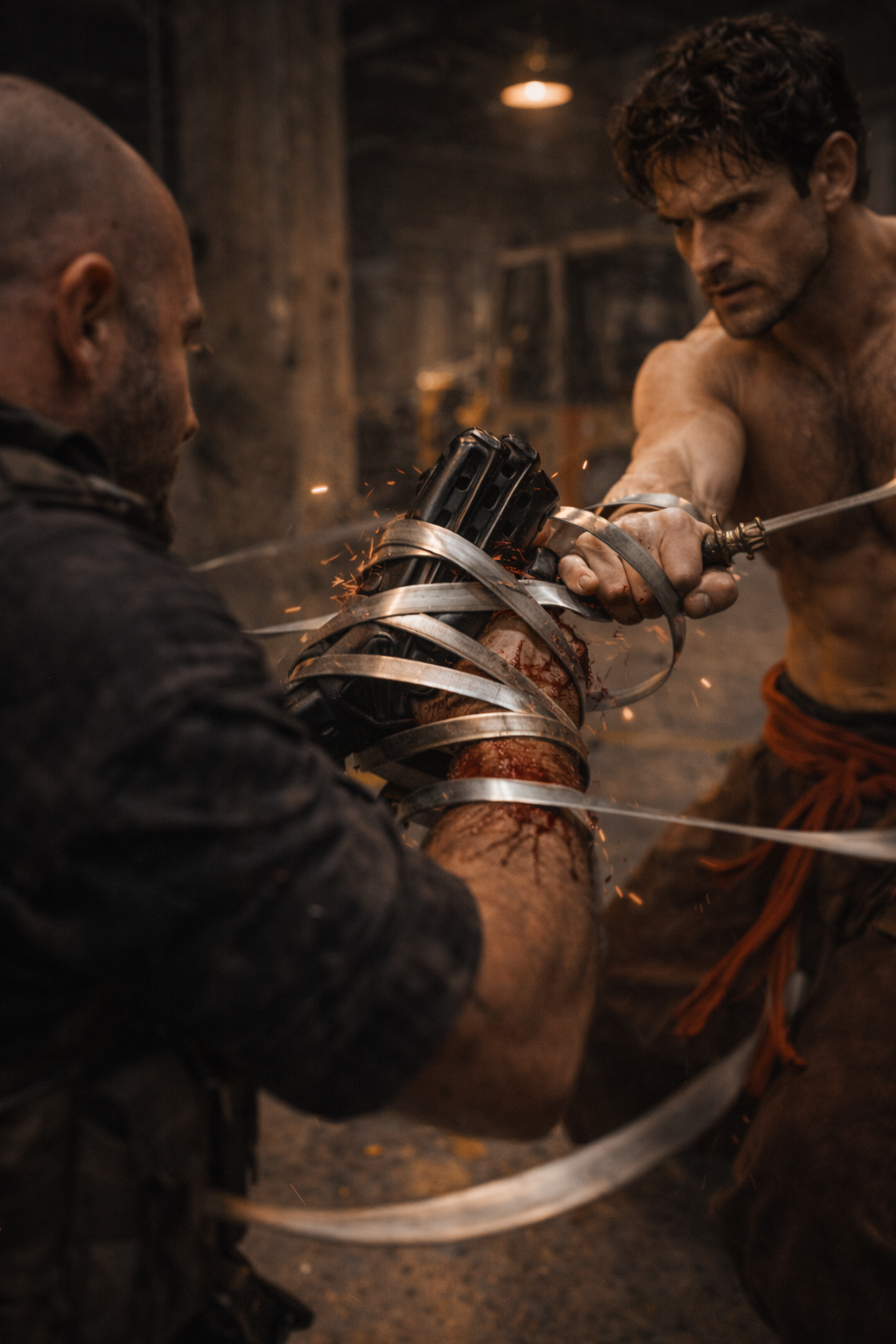
At twenty feet, Sting Ray snapped his wrist forward like a bullwhip. The three steel ribbons lashed out with blinding speed. They didn't slash; they entangled. The flexible blades wrapped violently around the barrel of the MAC-10 and the operative's forearms, the razor-sharp edges biting deep through the fabric of his tactical jacket.
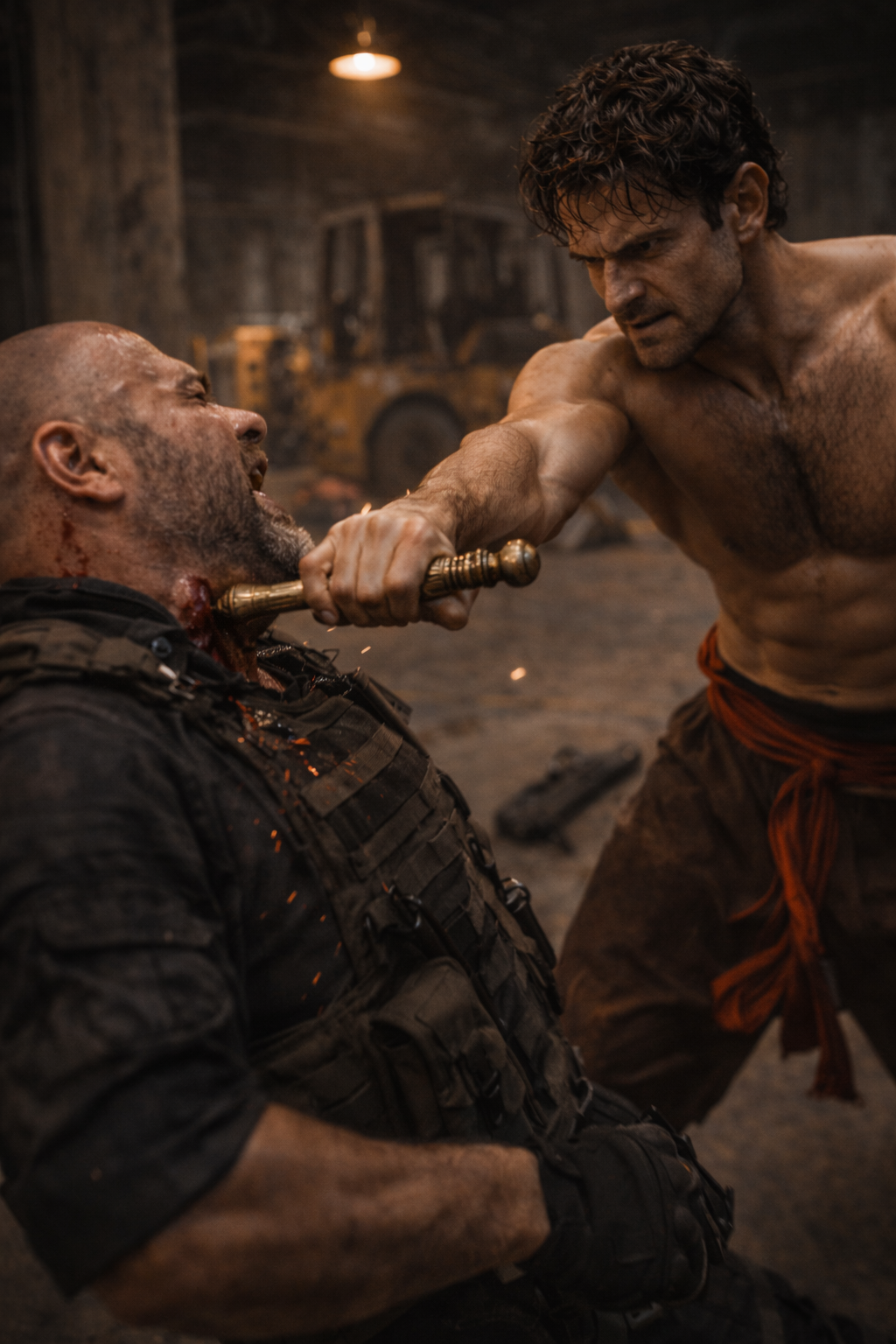
With a brutal, twisting yank, Sting Ray used the leverage to rip the machine gun out of the man's hands, sending it clattering across the concrete. Before the operative could draw a sidearm, Sting Ray closed the remaining distance. Using the heavy brass handle of the Urumi, he delivered a precise, devastating strike to the man's collarbone, dropping him instantly.
The fight was over. It was beautiful, violent mathematics.
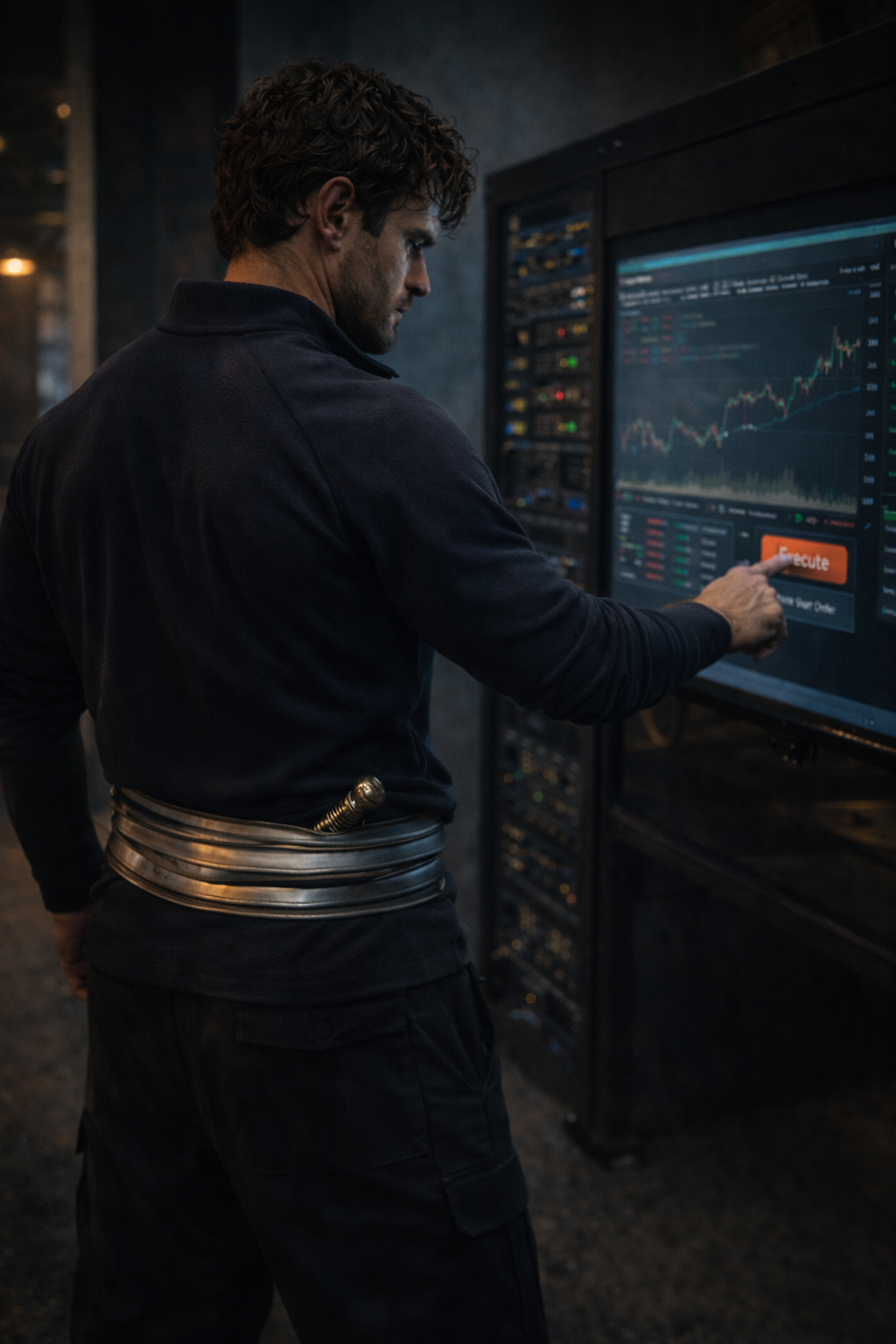
Sting Ray stepped over the groaning bodies, his breathing perfectly regulated, the sweat finally cooling on his skin. He coiled the steel ribbons back around his waist, adjusted his breathable knit jacket, turned back to the glowing terminal, and hit Execute on a billion-dollar short position.
The Quant Toolkit